



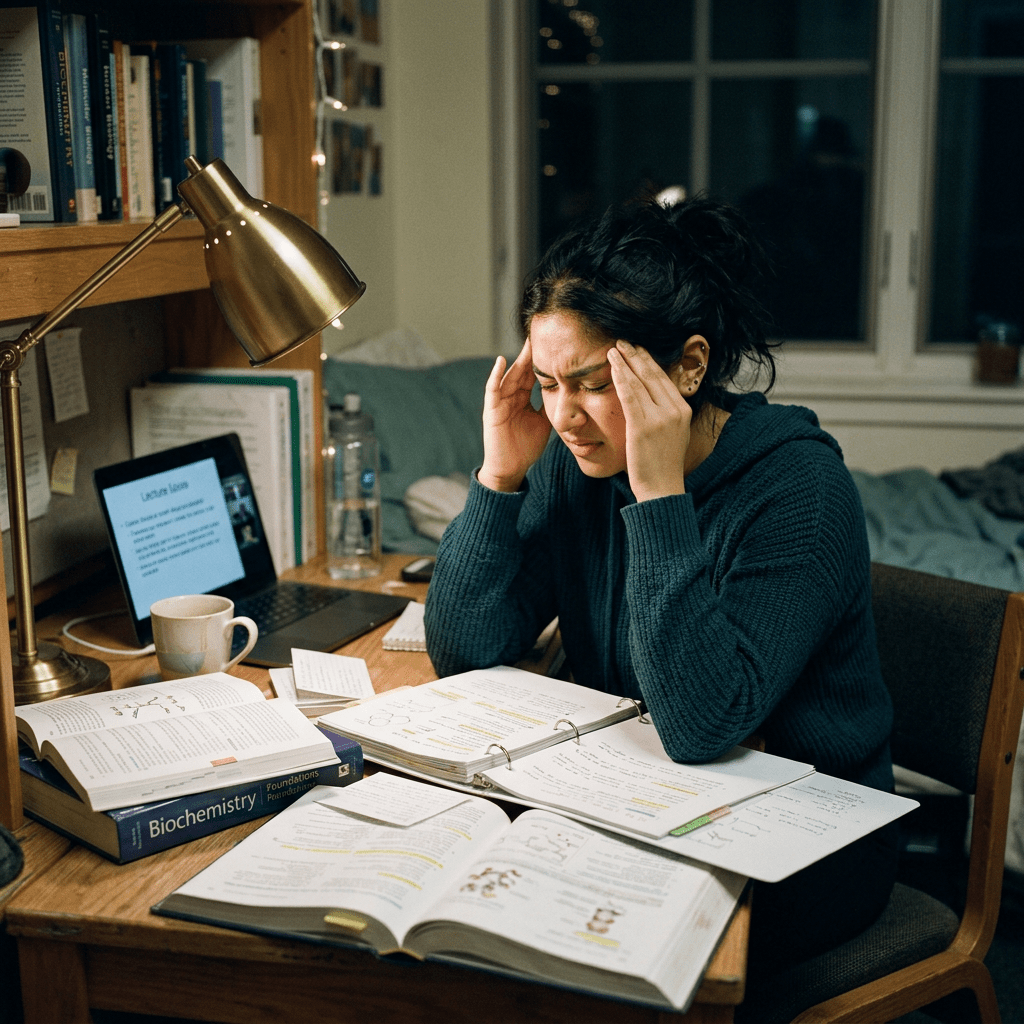

Racing heart, sleep problems, zero concentration — and the exam is still a week away. Almost everyone who has gone through an intensive learning phase knows exam stress. The problem is not the stress itself, but that it is strongest precisely when you need a clear head.
In this article, you will learn what triggers exam stress, what the typical symptoms are — and above all, what really helps against it. From quick immediate aids to structured strategies for the entire exam period.
Key takeaways
- Exam stress is acute pressure during the exam period — clearly distinguishable from chronic exam anxiety.
- Typical symptoms: racing heart, sleep problems, poor concentration, gastrointestinal issues.
- Exercise, sleep, and structured learning are the most effective countermeasures.
- Herbal remedies like valerian or ashwagandha can provide short-term support.
- The feeling of being unprepared is the biggest stress amplifier — a concrete plan helps immediately.
- Knowing all options makes you calmer for the exam — even accounting for the worst-case scenario.
Contents
What is exam stress — and what is it not?
Exam stress is an acute reaction to impending exam situations. It arises from the awareness that an important performance will be evaluated — and that time, energy, or knowledge are scarce. This is initially a completely normal biological reaction: the body mobilizes resources, sharpens attention, increases heart rate.
It's important to differentiate it from exam anxiety: While exam stress is situational and temporary — meaning it occurs specifically during the exam phase or exam period — exam anxiety is a chronic pattern that can also occur weeks before an exam or just at the thought of it. Stress is acute. Anxiety is more deeply rooted.
Exam stress = "I still have so much to learn and too little time." Exam anxiety = "I will fail no matter how much I study." Both can overlap but require different strategies.

Recognizing Exam Stress Symptoms
The symptoms of exam stress manifest on three levels — physical, cognitive, and emotional. Recognizing them early allows for more targeted countermeasures.
Physically, exam pressure often manifests as a racing heart, sweating, sleep problems, or gastrointestinal issues. Many also report headaches and a general feeling of exhaustion — even though they have accomplished little. The body is essentially running on overdrive in neutral.
Cognitively, stress shows up as concentration problems, blackouts during study, and the feeling that nothing "sticks." Those who experience this often fall into the trap of cramming — studying even more, increasing the pressure, and even less remains in memory.
Emotionally, irritability, lack of motivation, and the feeling of helplessness towards the subject matter are added. This is the point at which normal exam stress can become distressing.
If symptoms such as insomnia, panic attacks, or severe physical discomfort persist for several weeks, you should seek professional help. This goes beyond normal exam stress.
When the pressure becomes too much
Sometimes a concrete Plan B is enough to clear your head — discreet support can make all the difference.
Learn moreWhat helps against exam stress?
The question "Exam stress — what helps?" has no single answer, but some measures are scientifically proven to be particularly effective. First and foremost: stress mainly arises from a feeling of loss of control. Anything that gives you the feeling of having the situation under control directly reduces stress.
Structured learning is the most powerful antidote. Not learning more — learning better. A realistic study plan that divides the material into manageable daily portions measurably lowers stress levels. The brain needs the feeling of progress. Small achievable goals instead of the vague demand to "know everything."
Exercise is physiologically one of the most effective stress reductions there is. 20–30 minutes of moderate exercise releases endorphins, lowers cortisol levels, and improves sleep quality — all three factors directly relevant to the exam period. Those who completely forgo exercise during the exam period lose an important buffer.
Prioritizing sleep is not a weakness, but a strategy. The brain consolidates learned material during sleep. Those who study through the night lose more in retrieval performance the next day than they gained during the night.

- Create a study plan: small, achievable daily goals instead of vague overall goals.
- 20–30 minutes of daily exercise: lower cortisol, improve sleep.
- Don't sacrifice sleep: The brain continues to learn during sleep.
- Plan breaks: Pomodoro technique (25 min study, 5 min break) prevents mental exhaustion.
- Avoid social isolation: Short conversations with friends or family relieve pressure.
Exam Stress Pills & Herbal Remedies
Many seek chemical support during exam periods — from herbal remedies to over-the-counter preparations. This is legitimate, as long as expectations are realistic: no remedy replaces structured learning or adequate sleep.
Among herbal remedies for exam stress, valerian (sleep-promoting, to be taken in the evening), ashwagandha (adaptogenic, dampens cortisol response during chronic stress), and passionflower (calming, anxiety-relieving) have gained a good reputation. Bach flower remedies like Rescue Drops are used by many students during exam periods — the effect is individual, but the placebo effect with stress is real and not to be underestimated.
If you are considering pills or stronger remedies, you should definitely read our detailed guide to medications for exam anxiety — it explains the mode of action, risks, and over-the-counter options in detail.
Caffeine temporarily increases concentration, but also cortisol levels. Those who are already stressed exacerbate physical stress symptoms by drinking too much coffee. In the afternoon, caffeine is counterproductive — it sabotages sleep, which is crucial for exam preparation.
Exam Stress during the Exam Period — the Roadmap
The exam period is the most intense time of the semester. Multiple exams in quick succession, little recovery time in between, social pressure from all sides. Anyone who enters the exam period without a plan will be overwhelmed by it.
A concrete roadmap for the exam period: First, enter all exam dates into a calendar and plan backward — which exam needs how much preparation time? Then plan buffer days, no completely scheduled days until the exam. The last night before each exam is reserved for review, not initial learning.
Between exams: at least half a day of real break. Anyone who jumps directly from one exam to the preparation of the next is running on empty — and this becomes noticeable at the latest in the third or fourth exam of the period.
Security brings peace of mind
Knowing that you have a plan for the worst-case scenario automatically makes you more relaxed when taking the exam.
Learn morePlanning for the Worst-Case Scenario
There are exams where, despite good preparation, the feeling remains: "What if it's not enough?" This feeling is one of the strongest stress amplifiers there is — the uncertainty about the outcome. A simple antidote: concretely planning for the worst-case scenario.
What happens if you fail? Is there a resit? How many attempts do you have? Anyone who has answered these questions concretely takes away the diffuse threat of the worst-case scenario. This alone measurably reduces exam pressure.
Furthermore: Anyone who knows that they are aware of all possible options for the worst-case scenario — including discreet technical support — enters the examination room with a different feeling. Not because they intend to use them, but because the security of having a fallback option dampens acute stress.
Exam stress is normal. It shows that the outcome is important to you. But it doesn't have to block your thinking — with the right roadmap, suitable tools, and a concrete Plan B, you can navigate even the most intense exam period with a clear head.
"The biggest stress factor is not the exam itself — but the feeling of being helplessly at its mercy."

