



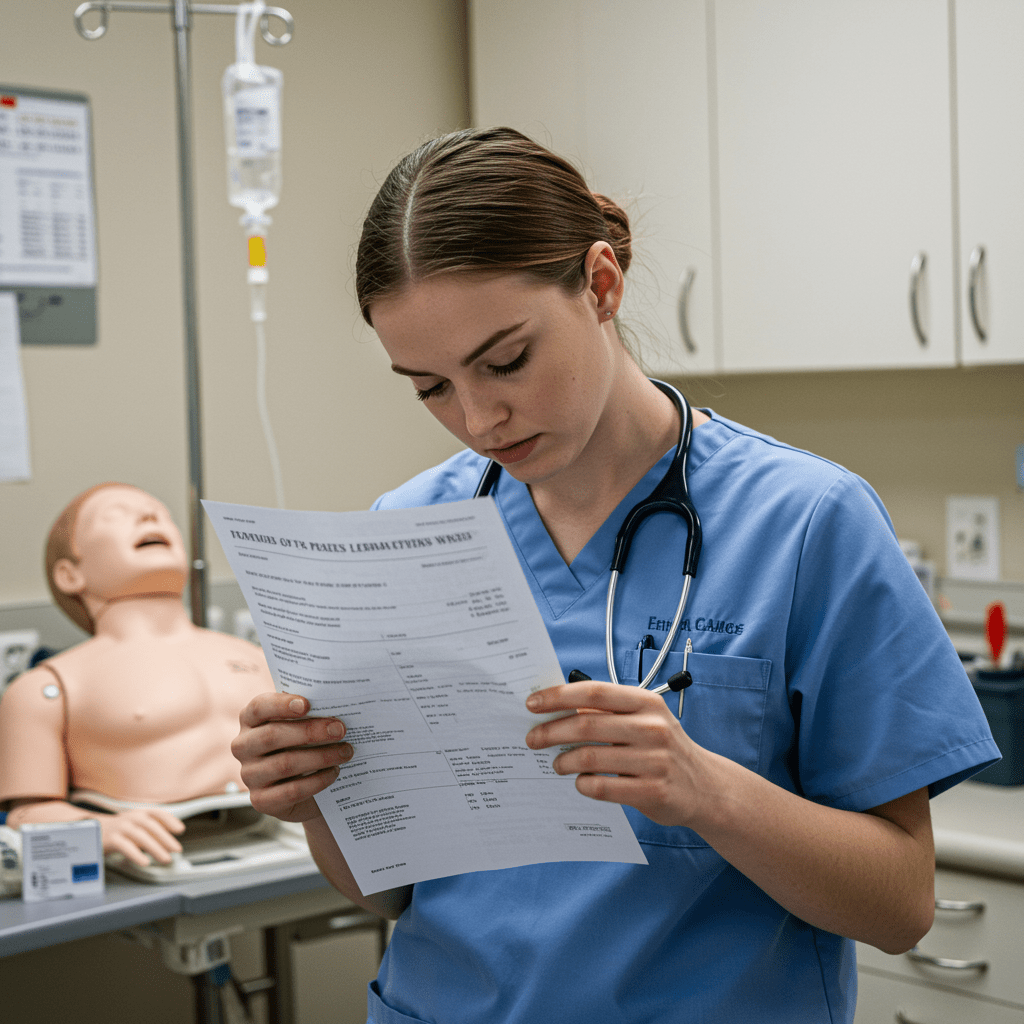

Failing the generalist nursing education exam – this affects 12-15% of all trainees. After three years of training, it's a shock, but no reason to panic. You have exactly one retake per exam part – meaning two attempts in total. The good news: most pass on the second attempt.
This article explains the retake regulations for written, oral, and practical exams, why so many fail the practical exam, and your options after ultimately failing.
Key takeaways
- 1 retake per exam part - 2 attempts in total (§ 19 para. 3 PflAPrV)
- Only failed parts must be retaken
- Training contract can be extended upon request until the retake exam (max. 1 year)
- Practical exam has the highest failure rate (12-15%)
- After the 2nd failed attempt in an exam part: definitively failed
The three exam parts of the generalist nursing education
The final exam consists of three parts, all of which must be passed individually. Each part must be graded at least with "sufficient" (grade 4.0):
The overall grade is calculated from the average of all three exam parts. However, each part must be passed individually – a good grade in one part cannot compensate for failing another.

Exam failed - what then?
If you fail one or more exam parts, you have exactly one retake per exam part. This means two attempts in total per part. This is regulated in § 19 paragraph 3 of the Nursing Professions Training and Examination Ordinance (PflAPrV).
Only the failed parts must be retaken – passed parts remain valid. Each individual written exam, the oral exam, and the practical exam can be retaken once (§ 19 para. 3 PflAPrV). At your request in text form, your training contract will be extended until the next possible retake exam, for a maximum of one year (§ 21 para. 2 PflBG). If you also fail the retake, the state examination is definitively failed.
Practical Examples
To illustrate this, here are specific scenarios:
- One written exam failed: You only retake this one written exam. The two passed written exams, as well as the oral and practical exams, remain valid.
- Only practical exam failed: You only retake the practical exam with the patient.
- Written AND practical exam failed: You retake both parts separately.
- All three written exams failed: You retake all three – however, you will only be admitted to the retake exam after additional training (§ 19 para. 4 PflAPrV).
Similar to other apprenticeships, there are clear legal regulations for repeat examinations.
Why do so many fail the practical exam?
The practical exam has the highest failure rate at 12-15%. The most common reasons:
1. Nervousness with a real patient
Unlike exercises with a dummy, the practical exam is conducted with real patients. The examination situation plus responsibility for a real person often leads to blackouts. Many trainees can perfectly perform the procedures in training but fail under exam pressure.
2. Inadequate nursing documentation
Many fail not due to practical execution, but due to written documentation. The nursing care plan must be complete, technically correct, and comprehensible. Those who neglect documentation during the exam often fail – even with perfect practical performance.
3. Time management
The practical exam lasts about 4 hours. Those who do not manage their time correctly fail to complete important steps or document incompletely. Time management must be practiced intensively beforehand.
4. Lack of patient-oriented communication
Communication with the patient is assessed. Those who merely "go through the motions" without explanations, empathy, and patient-oriented address often fail. Examiners pay attention to how you interact with the patient.
Hygiene measures forgotten or incorrectly performed, documentation incomplete or incorrect, no patient-oriented communication, time schedule not adhered to, inability to justify nursing measures, misjudgment of emergency situations.
Exam in a critical phase?
Even in hopeless situations, there are discreet ways to ensure security
Learn moreWritten exam failed
The written exam consists of three tests covering different competency areas. Failure rate: 8-10%. Most common reasons:
- Gaps in specialist knowledge: Especially in nursing processes, nursing care planning, and legal foundations
- Time pressure: 120 minutes per exam is a tight schedule – time management is crucial
- Misunderstanding of tasks: Open questions are answered too superficially or off-topic
- Lack of exam preparation: Those who have not practiced old exams often fail due to the exam format
Important: You only retake the exams that were graded "unsatisfactory" or "fail" – passed written exams remain valid (§ 19 para. 3 PflAPrV). Only those who have to retake all three written exams will be admitted to the retake examination after additional training (§ 19 para. 4 PflAPrV).

Retake failed - what then?
If you fail the retake of an exam part, the state examination is considered definitively failed. You cannot complete the generalist nursing education.
A renewed nursing education with another provider is usually not possible, as the examination is valid nationwide. You will have to reorient yourself professionally.
Alternatives after definitive failure
- Nursing assistant training: 1-year training as a health and nursing assistant - no state examination
- Other health professions: Medical assistant, paramedic, physiotherapy training
- Career changer jobs: With 3 years of nursing experience, often good chances in nursing homes without a degree
- Professional reorientation: As with dropping out of studies, there are many paths to reorientation
Important: Even with definitive failure, your three years of training are not in vain. The practical experience and specialist knowledge are valued by many employers in the healthcare sector.
Successfully master the retake
- Obtain and analyze detailed exam feedback from the examination committee
- Targeted learning of failed areas with tutoring or a refresher course
- Repeatedly simulate the practical exam with colleagues and instructors
- Work through old exams under realistic time pressure
- Seek professional psychological help for severe exam anxiety
- Practice time management intensively - especially for the practical exam
Typical mistakes during retakes
Many repeat the same mistakes: starting preparation too late, focusing incorrectly (detailed knowledge instead of basics), not conducting exam simulations. Those who use the same learning strategy for the second attempt as for the first often fail again.
Conclusion: Generalist nursing education exam failed
- 1 retake per exam part - 2 attempts in total (§ 19 para. 3 PflAPrV)
- Only failed parts must be retaken
- Practical exam has the highest failure rate (12-15%)
- Training contract can be extended upon request until the retake exam (max. 1 year)
- After the 2nd failed attempt in an exam part: definitively failed
- Alternatives: Nursing assistant, other healthcare professions, reorientation
A failed nursing exam is not the end of the world. Most pass on the second attempt if they specifically address their weaknesses and prepare better for the examination situation. The practical exam, in particular, can be significantly improved through intensive practice and simulation.
"In nursing, not only specialist knowledge counts, but also empathy and calmness under pressure. The retake is your chance to show exactly that."
